

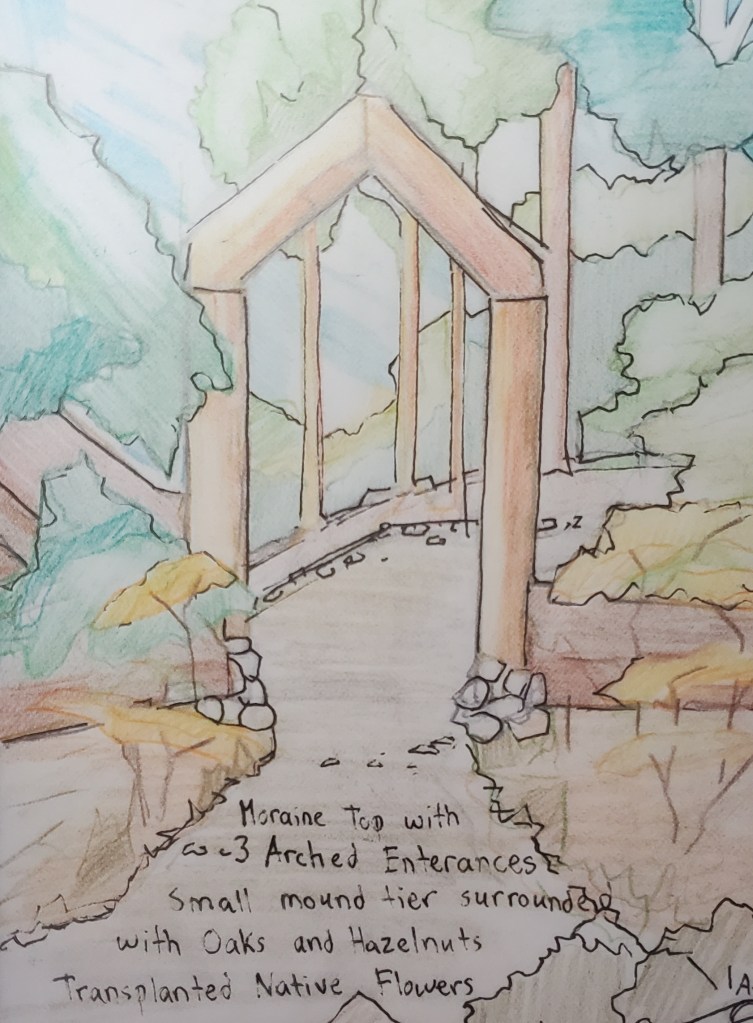
Part of my mission here is to inspire people to reconnect with the garden resting in their internal landscape. What follows is a beginning demonstration of how to shape land with a spirit of stewardship. These are a few sketches I created while envisioning how to weave a sense of sacred experience into outdoor exploration.
About a week ago, I was exploring the new area I recently moved to. A significant river and creek system runs through the region, flanked by stretches of wild easement. In one secluded area, I discovered a large glacial moraine with a striking point that juts out over a steep incline. At the base of this slope, seasonal waters gather into a quiet basin.
While visiting this spot—and after spending time listening, thinking, and feeling into the space—I decided to begin working with the land. After just four hours of gentle engagement, I made more progress than expected. I started by simply listening: asking what the land wanted, how it could be shaped in a way that benefited both wildlife and passing hikers. I paid attention to the natural curves already present and considered where to introduce gentle straight edges to frame the experience.
Below is a conceptual sketch of my vision
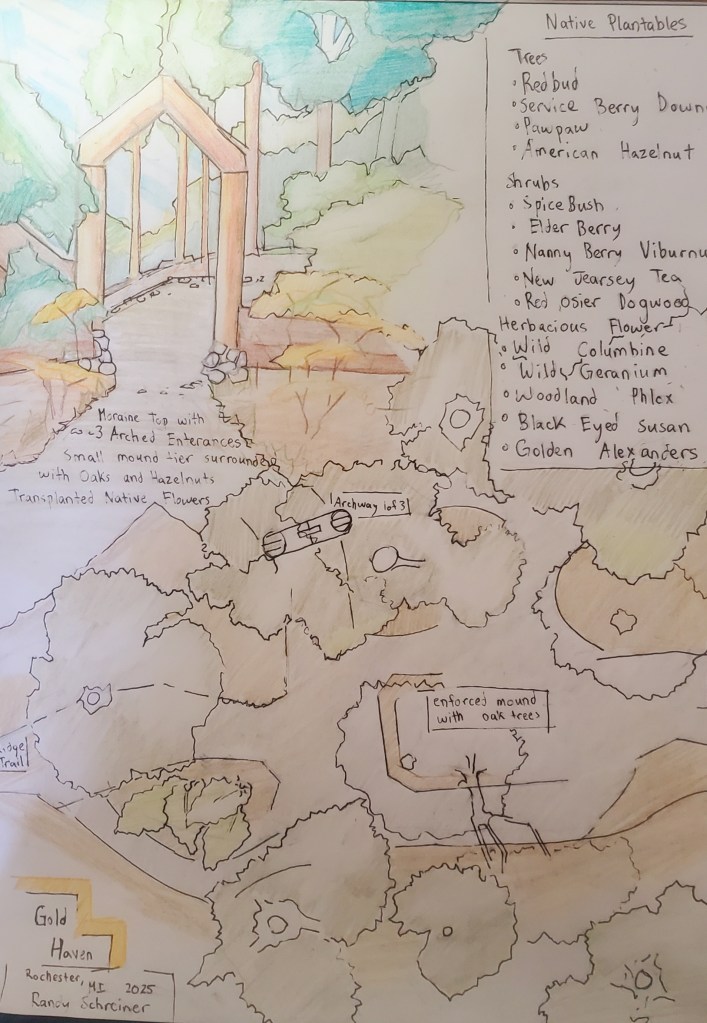
This starting phase is a unique and vital time. It’s where material meets imagination—where you begin learning about your resources, the labor required, and the aesthetic you’re hoping to evoke. If this is a personally led project, I find it best to work alone, especially if your vision is specific or spiritually anchored. There’s an old belief that creatives often work best in solitude—and in many respects, I agree. I say this only because I asked a friend for input, and when he offered suggestions, I found myself replying, “No.” That moment reminded me of the importance of drawing out a clear design first—so that if others do help, they can participate in a shared vision.
Some of the first steps in surveying the location involved sourcing natural building materials—fallen limbs, stones, bricks, even transplantable plants. If you’re considering building steps, decks, or resting platforms, ask: do you have enough local stone or wood to bring that vision to life? Exploration often reveals surprises. In this location, the sand beneath the loam turned out to be a rich, golden color. My plan is to collect this sand from a nearby hillside and apply it to the trail surface—giving it a unique golden tone that reflects the landscape’s character.
I’ve begun caching some tools in the forest nearby. Essentials include a shovel and a light pick mattock. You might also find use in a bucket, loppers, a large handsaw, hammer, chisel, rock rake, and, if you’re hauling materials, a strong backpack that can carry stones or gravel. Depending on the terrain, you might also consider a rock bar, a come-along, and simple rigging supplies.
Next, I plan to construct the first archway, once I finish shaping the trail bed. I’ll be sure to share updates on the process as it unfolds.
 Ancient Refuge
Leave a comment