

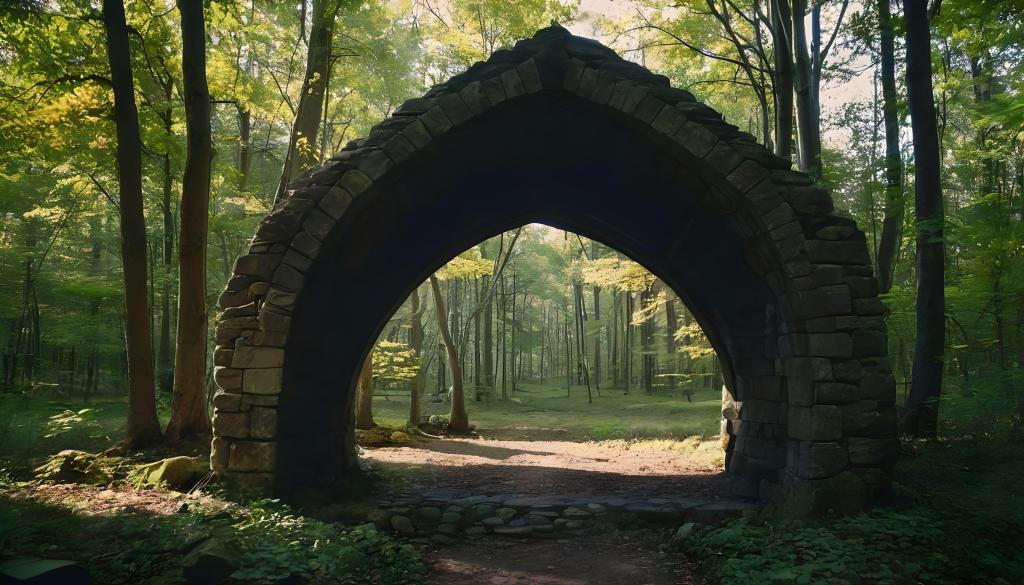
Sometimes often contemplate the reasons why we, as a human species, have so much conflict — the clashes between religions, nations, and identities.
Much of it, I feel, comes from being handed scripts that contain subtle or even direct lies.
Because of this, we have lost touch with who we are and what we have been — lost to the forgotten moments of time.
We’ve been taught many conflicting perceptions of the world.
A common conflict I notice is how approaching spirituality through nature is labeled “pagan,”
while contemplating Christ in black-boxed churches every Sunday is often seen as oppressive.
These two spiritual positions, by default, have been set against each other —
and have been at war for at least a thousand years.
But maybe the clearer truth is that there was never a need to be in opposition.
Heaven and Earth were never meant to be enemies — they were intended to merge, not divorce.
Yet through endless years of factional abuse and division, the trauma became deeply rooted,
and today it still manifests itself all around us.
Political power structures have fueled much of the animosity between peoples.
We can see this if we look, even simply, at the Nag Hammadi Scrolls,
written around 50 years after Jesus’ life by a group called the Essenes.
Their writings spoke openly of how nature and heaven were not opposed —
though they acknowledged how imbalance had crept into the world.
Compare this to the standard four Gospels, which mostly derived from a source text called “Q” —
but were compiled around 150 years after Christ’s time.
If you dig deep enough into any tradition, you’ll often find the unalienable truths
are out of sync with the official timelines and structures we were taught.
The early Catholic Church is one of these examples.
After the Roman Empire fell under pressure from northern tribes,
the Church was reduced to a small region in central Italy.
It became politically advantageous for the Pope to grant Charlemagne the so-called
“divine right of kings” — a repackaging of Roman emperor rule under a Christian name.
It was a savvy ploy to extend political force under a new banner —
but at great spiritual cost.
This transition nearly eliminated the earlier Christ-centered spiritual paths
that communed with nature.
It also largely erased the feminine presence of love and compassion within the church —
something that stands in stark contrast to the life Jesus actually lived.
Even before his crucifixion,
Jesus went to nature to pray, not to the temple.
Luke 22:39
“Jesus went out as usual to the Mount of Olives, and his disciples followed him.”
He also taught that peacemakers would be blessed — not warmongers.
Yet, ironically, religion was weaponized to push political agendas,
often under the naïve assumption it was for someone else’s good.
When Charlemagne was crowned “Emperor of the Romans” by the Pope in 800 AD,
it forcibly ended much of the older, gentler forms of Christianity and earth-honoring spirituality across Europe.
Before Charlemagne:
- Christianity in places like Ireland, Gaul (France), and Britain was deeply peaceful, mystical, and land-rooted.
- It was often interwoven with older Celtic, Druidic, and indigenous traditions —
seeing Christ not as a conqueror, but as a Light blessing the sacredness already present in the land.
After Charlemagne:
- Christianity became militarized and centralized under the authority of the Roman Catholic Church.
- Uniformity was demanded.
- Local variations of faith — like Celtic Christianity — were branded as heretical or pagan.
- Missionary armies were sent across Europe, especially into Saxony and Slavic lands, to enforce conversion by sword:
- Forced baptisms,
- Destruction of sacred groves,
- Burning of ancient texts,
- Abolishing women’s leadership in spiritual life.
- Peaceful monasteries focused on contemplation and connection to nature were replaced by fortress-monasteries tied to feudal power.
- Ancient wells, stones, and forests were either renamed under Roman saints or destroyed outright,
breaking the memory of the older ways.
Archeological Remnants of the Lost Story
There are small hints of Celtic Christian influence if we are wise and patient enough to piece them together.
Here are a few sacred places in France that still whisper fragments of this hidden story —
reminding us that the cultural landscape may have been very different before towers, walls, and swords became canon.

Ancient Sacred Sites of France (Pre-Charlemagne)
Mont-Saint-Michel
A mist-cloaked tidal island once sacred to Celtic water spirits, later dedicated to the Archangel Michael.
Pilgrims believed the tides themselves were a voice of God.
Chartres Cathedral
Built atop a Druidic sacred well.
Beneath the cathedral lies a Black Madonna — symbolizing the sacred feminine and the Earth’s living womb.
Vézelay (Basilica of Mary Magdalene)
Pilgrimage center honoring Mary Magdalene, blending ancient healing rites of the land with Christian mysticism.
Its lightstone façade still glows today like a beacon.
Saintes
An ancient Roman-Christian town where early earth-based communities worshiped Christ among the ruins and rivers of old Gaulish temples.
Le Puy-en-Velay
Built upon volcanic rock formations.
Sacred since prehistoric times, it became a Marian pilgrimage site where mystics believed the heavens and earth touched.
Grotte de Sainte-Baume
A deep cave hidden in the Provence forests.
Legend says Mary Magdalene lived her final years here — in prayerful communion between heaven and earth.
Celtic Clothing Influence on France (Circa 1200)
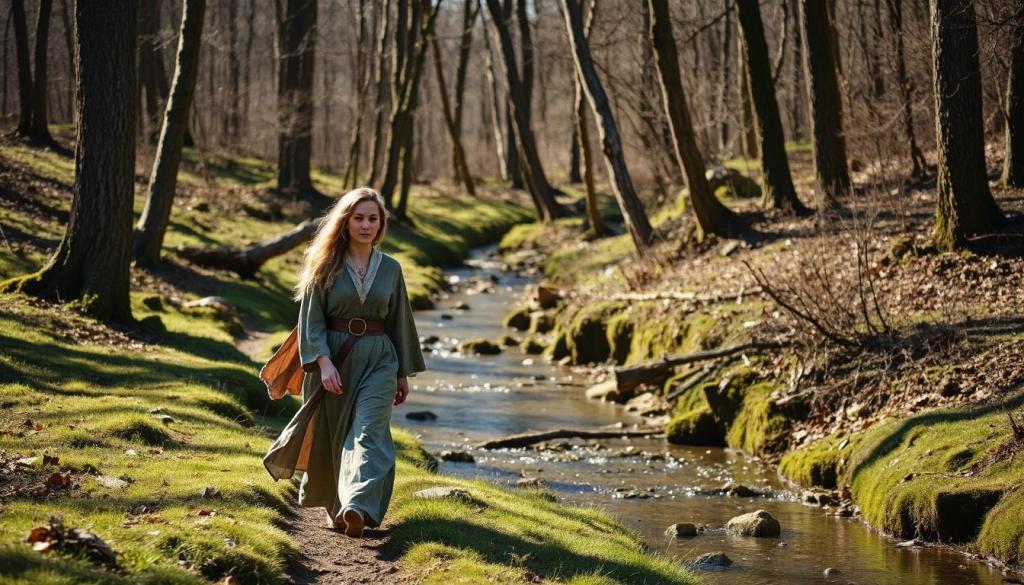
Other evidence of this earth-loving spirituality can be found by studying the clothing styles of France around 1200.
After centuries of quiet blending, Celtic clothing styles influenced early French dress —
especially in rural and spiritual communities.
- Simple, flowing garments made from natural materials like wool and linen.
- Cloaks (brats), tunic-dresses (leines), and decorative brooches carried forward into French peasant and monastic life.
- Soft, natural dyes — ochres, blues, greens — stayed popular, reflecting a continuing love for the land’s colors.
An example of Celtic-Christian memory around 1200:
At Chartres Cathedral, fragments of cloth found in the crypt show
that pilgrims and monks wore woolen garments embroidered with subtle spirals, vines, and tree-like patterns —
not only crosses.
These patterns echoed ancient Celtic designs,
which saw life as a continuous, sacred spiral connected to land, sky, and Spirit —
not a linear march of conquest.
Even under Roman influence, the sacredness of the earth was still quietly woven into daily life —
stitched into every fold and seam.
Memory Survives
A vibrant, Christ-loving, earth-connected spirituality was broken by empire…
but it was never destroyed.
It survives:
- In the folk traditions,
- Amongst the ruins,
- Through the woven patterns of clothing,
- In the hidden sacred wells and stones,
- And now — in people like you, remembering.
 Ancient Refuge
Leave a comment